8 Local Seed Sources That Will Change How You Garden in Florida
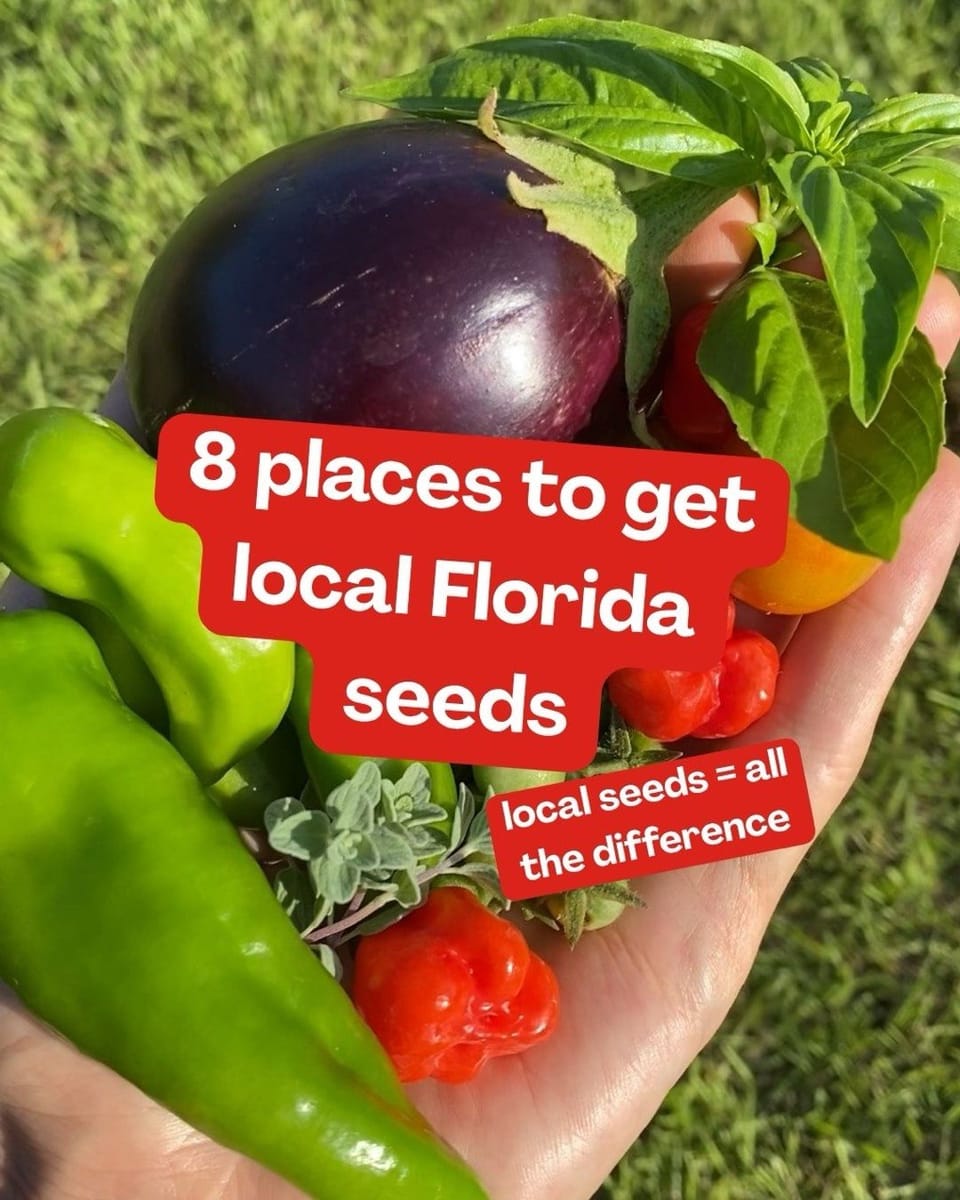
Why Local Beats Big-Box Every Time
You ever plant a seed packet from a big-box store...
water it faithfully... wait...
...and then realize Florida just rejected it completely? 🥺
Same soil. Same sun. Same effort.
But somehow, half the garden struggles while the other half barely survives.
It’s not you. (It’s the seed.)
Most commercial seeds are bred to withstand shipping, superficial uniformity, and a looooong shelf life, not for Florida’s heat, humidity, sandy soil, and nutrient absorportion.
Meanwhile, there are growers right here in Florida quietly working with nature instead of against it, saving, adapting, and sharing seeds that actually thrive in this environment.
And once you grow with those... oooph!
it’s really hard to go back.
📖 Table of Contents
- 🌱 Why Localized Seeds Matter More Than Ever
- 1️⃣ Growin' Crazy Acres – Spring Hill, FL
- 2️⃣ Cody Cove Farm & Nursery – Babson Park, FL
- 3️⃣ ECHO (Echo Village) – North Fort Myers, FL
- 4️⃣ Seed The Stars – Central Florida
- 5️⃣ The Urban Harvest – St. Petersburg, FL
- 6️⃣ Urban Abundance – Jupiter, FL (Farmer Jack)
- 7️⃣ Jerra’s Garden – Orlando, FL
- 8️⃣ FL Gardening by Josh – Tampa, FL
- 📍 Where You Fit Into This (Even If You’re Not a “Seed Company”)
- 🌟 A Different Kind of Food System (Built By Gardeners)
Florida gardeners do best with locally adapted, open-pollinated seeds because they’re selected for heat, humidity, pests, and sandy soils that big-box seed varieties are not bred for. Period.
🌱 Why Localized Seeds Matter More Than Ever
Here’s the quiet truth most gardeners eventually discover:
Not all seeds are created for the same world.
Corporate seed systems optimize for things like:
- Long-distance shipping
- Consistent appearance
- Shelf stability
But Florida isn’t a controlled environment.
It’s intense. Relentless even!
And seeds that haven’t been grown, saved, and selected here often just fail. These people (as you will see) also collect and grow things that national mainstream seed places don't even know about!
Local seed stewards flip that equation.
They’re working with:
- Open-pollinated and heirloom varieties
- Real-world Florida conditions
- Generations of adaptation and seed-saving
Which means you get plants that:
- Handle heat without collapsing
- Produce through long seasons
- Actually taste like something
And maybe more importantly...
You’re participating in something bigger than just a harvest.
You’re helping keep seed genetics alive, decentralized, and in the hands of real people, not locked behind patents or supply chains.
So here are 8 Florida seed stewards who are doing this work right now, and making it easier for the rest of us to grow like we mean it.
1️⃣ Growin' Crazy Acres – Spring Hill, FL
Growin’ Crazy Acres has built quite a reputation here in Florida. They’ve been hand-packing Florida-tested heirloom seeds since 2008. Not guessing what might work, but actually growing and trialing varieties in real conditions.
Everything is:
- Open-pollinated
- Non-GMO
- Selected for Florida resilience
And it shows I tell ya.
The Ping Tung Long Eggplant?
Dense, almost nutty & creamy. The kind of flavor that makes you pause mid-bite.
Golden Marconi Peppers? Tested & loved them!
Sweet, productive, and forgiving even in containers.
Japanese Minowase Daikon?
Crisp, and surprisingly easy to grow here in the fall/winter/ early spring.
They also include practical planting guidance, which in Florida is half the battle.
If you’ve ever felt like “maybe I just suck at growing eggplant”... try their varieties before blaming yourself.
Growin' Crazy Acres Check them out!
2️⃣ Cody Cove Farm & Nursery – Babson Park, FL
Some places sell plants.
Others feel like you’ve stepped into the future of food foresrty.
Cody Cove is the second kind.
Run by Josh Jamison, this is not just a nursery. It’s a living food forest overlooking Crooked Lake (great views on the way), filled with rare and resilient edible crops that actually want to grow in Florida.
Josh spent years managing the demonstration farm at HEART Village, and you can feel that depth of experience in everything here, and in his tours.
This is where you go when you’re ready to move beyond basics.
Standouts include:
- CAP 455 Pepper, thick-fleshed, sweet, and a conversation starter
- Zambian Cucumber, shrugs off heat and pests while traditional varieties give up
Walking this inspiring property shifts something in your mindset.
You stop asking, “What can I grow here?”
And start asking, “Why am I not growing more?”
Perfect if you’re building a food forest, or ready to think like someone who does. Be sure to sign up for his food forest walk throughs!
3️⃣ ECHO (Echo Village) – North Fort Myers, FL
If Florida had a hidden vault of agricultural resilience, this would be it. Food with a purpose!
ECHO is not just a seed provider.
It’s a global hub for discovering and distributing crops that thrive in the toughest environments on earth, including ours.
Their mission is simple, but powerful:
help communities grow food where it seems impossible.
And they do that by focusing on underutilized plants. The ones you will not find in stores, but absolutely should know about.
On-site, you’ll find:
- A global seed bank
- A working demonstration farm
- Workshops and educational programs
- An extensive nursery of tropical and subtropical crops
This is where you discover things like:
- Perennial greens that do not quit in summer
- Starches that grow where potatoes fail
- Crops that feel completely new, but make total sense here
Spend a few hours at ECHO, and your idea of what a garden looks like starts to expand.
If you’re thinking long-term, food security, resilience, or a true food forest, this place is foundational.
ECHO (Echo Village) <<-- Video Tour
4️⃣ Seed The Stars – Central Florida
Some growers experiment. Others observe closely, season after season, and only keep what actually performs.
Seed The Stars leans into that second approach.
Everything they offer is grown and trialed right here in Florida, under real conditions, not ideal ones. What makes the cut are the varieties that consistently show up strong.
Think of it as a curated lineup of “proven winners” for this climate.
You’ll find things like:
- Orange Bulldog Pumpkin, a disease-resistant Cucurbita maxima that holds up better than most
- Korjaj Sorghum, both productive and visually striking
- Loofah Gourds that thrive here
They also offer well-rounded collections of tomatoes, peppers, greens, okra, (...just about everything really..) all selected from top-performing plants.
There’s a quiet confidence in this kind of curation.
Not everything makes the list.
Only what earns its place.
If you want to skip trial-and-error and start with varieties that already proved themselves in Florida, this is a solid move.
5️⃣ The Urban Harvest – St. Petersburg, FL
A lot of people think you need land to grow serious food in Florida. Elise Pickett built her entire approach proving the opposite.
Starting on a modest urban lot, she turned small-space gardening into something both practical and inspiring. Not theoretical. Not Pinterest-perfect. Real.
The Urban Harvest is more than seeds. It’s an ecosystem of:
- Tutorials
- Classes
- Deep-dive YouTube content
- Hands-on guidance for Florida growers
The seeds themselves are carefully selected heirlooms suited for subtropical conditions, but the real value here is the education layered on top.
You’re not just buying seeds. You’re learning how to work with them.
If you’re starting small, or feel limited by space, this is one of the most empowering places to begin.
6️⃣ Urban Abundance – Jupiter, FL (Farmer Jack)
Some people help you grow plants.
Farmer Jack helps you redesign your entire relationship with your yard.
Urban Abundance offers full-service edible landscape design, installation, and maintenance across South Florida. They do not just hand you plants and wish you luck. They step in, assess your space, and transform it into something productive. And if something is not thriving, they come in, and either support it or replant it with a better more suitable variety for that microclimate. It's really awesome!!
Think:
- Backyard food forests
- Edible landscaping that actually looks good
- Systems that keep producing year-round
Buuuuut, they also operate a nursery (and a quaint farm store), but the real magic is in how they connect everything into a functioning system.
You go from “I hope something grows” to “this space feeds us.”
If you want to shortcut years of trial-and-error and turn your yard into something truly abundant, this is next-level support.
Urban Abundance Plant Nursery
Urban Abundance
7️⃣ Jerra’s Garden – Orlando, FL
A garden without flowers works.
But a garden with flowers comes alive!
Jerra’s Garden blends edible crops with Florida-native and pollinator-friendly flowers in a way that turns a growing space into an ecosystem.
And you REALLY feel the difference.
More movement.
More color.
More life.
Her seed selections include:
- Heirloom vegetables
- Native flower mixes
- Cut flowers that thrive in Florida conditions
And the results are not just productive, they are beautiful.
One simple packet of native flowers can completely change the energy of a space. It did for me and my garden! More pollinators. More balance. More resilience. Makes me just stand there and stare at flowers growing. Beautiful stuff.
If your garden feels a little one-dimensional, this is how you round it out into something complete.
Jerra’s Garden
8️⃣ FL Gardening by Josh – Tampa, FL
Some resources give you tips.
FL Gardening makes you feel like an experienced Florida grower is on your side, rooting for you, and helping you figure how things actually work.
Josh's seed collections are solid, but what really stands out is the depth of practical, Florida-specific knowledge across his blog and YouTube channel.
This is the kind of guidance that helps you avoid mistakes before you make them.
Timing, variety selection, expectations, it’s all grounded in real experience, not generic advice.
And that matters more than most people realize.
A good seed gets you started.
Good information keeps you going.
If you want to build confidence as a Florida grower, this is a resource worth keeping close.
FL Gardening
📍 Where You Fit Into This (Even If You’re Not a “Seed Company”)
Not everyone on this list started as a full-scale grower or nursery.
Most of them began the same way a lot of us do.
A backyard. A few successful crops. And more seeds or plants than they knew what to do with.
That’s where something shifts.
You realize your “extra” is not actually extra.
It’s useful to someone else nearby.
If you’ve ever had:
- A tomato variety that crushed it in your yard
- Extra seedlings you did not want to toss
- Saved seeds sitting in a jar with no real plan
- Or maybe you wanted to inspire the next generation towards something wholesome, meaningful, and empowering...
...then there’s a simple next step.
Platforms like OffTheLand.net make it easy to share, trade, or sell that abundance locally, without needing to be a business, a brand, or a professional grower.
It’s not about competing with the stewards above 🙌.
It’s about growing into one, in your own way, at your own pace.
Buy from them. Learn from them.
And when your garden starts producing more than you need, pass it on.
That’s how local food systems actually take root.
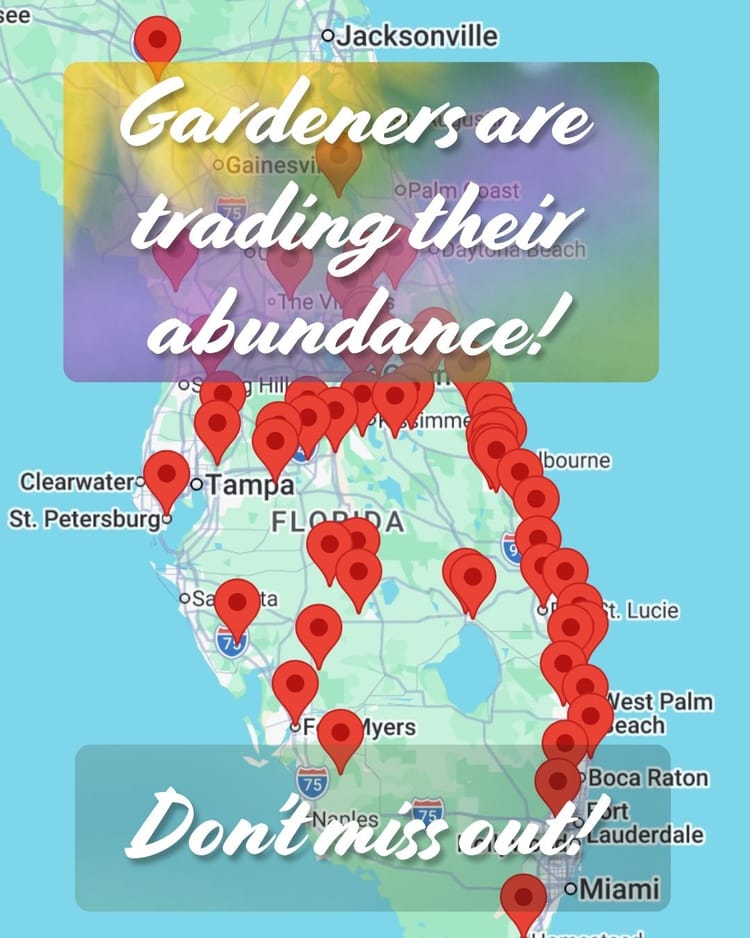
Gardeners trading and selling abundance on OffTheLand.net for free
🌟 A Different Kind of Food System
This does not require a massive shift.
It starts small.
A better adapted seed.
A stronger more productive plant.
A neighbor who grows something you do not.
Sharing, bartering, selling, locally with like-minded people.
And over time, those small decisions stack into support networks.
A local food system that belongs to the people growing it.
One that values flavor over shelf life.
Resilience over uniformity.
Connection over convenience.
Next time you are about to grab a seed packet off a big-box rack, pause for a second.
Ask yourself:
Who grew something like this 10 miles from me?
That question alone can change everything.
If you’re a Florida seed seller, nursery, or gardener with your own collection, drop a comment or reach out on social or email. We would love to feature more stewards and help connect them with people who are looking for truly local, transparent food.
OffTheLand.net
Real food, by real people. 🌱
Florida Gardening FAQ (Local Seeds, Soil, and Growing Smarter)
🌱 FAQ: Florida Gardening & Local Seeds
Why do seeds from big-box stores struggle in Florida?
Many commercial seeds are bred for uniformity, shipping durability, and broad national climates. Florida’s heat, humidity, sandy soils, and pest pressure are very specific, so varieties not adapted locally often fail to germinate, bolt early, or produce poorly.
What makes Florida-grown seeds different?
Florida-grown seeds are selected over time in real local conditions. This means better tolerance to heat, humidity, fungal pressure, and sandy soils. They are often open-pollinated, allowing gardeners to save seeds that remain adapted to their environment.
What is the best soil for gardening in Florida?
Most Florida soil is sandy, low in organic matter, and drains quickly. The best approach is to build soil over time by adding compost, mulch, and organic material. Many gardeners use raised beds or heavily amended in-ground systems to improve water retention and nutrient levels.
Why is Florida soil so sandy and low in nutrients?
Florida’s soils developed from marine sediments and ancient coastlines, which results in coarse sand with low organic content. Heavy rainfall also leaches nutrients quickly, making soil-building practices essential for long-term success.
When is the best time to plant vegetables in Florida?
Florida has two main growing seasons: fall/spring and summer. Many crops that are planted in summer in northern states are grown in Florida during cooler months. Summer is better suited for heat-tolerant crops like sweet potatoes, sorghum, zambian cucumber, chayote, loofah, etc.
Why do plants bolt quickly in Florida?
High temperatures and long daylight hours signal many plants, especially leafy greens, to shift from growth to reproduction. This causes bolting. Using heat-tolerant varieties and planting in the right season helps reduce this issue.
What are the easiest vegetables to grow in Florida?
It all depends on the season! Reliable crops for Florida summers include sweet potatoes, sorghum, chayote, loofah, Seminole pumpkin, zambian cucumber, etc. These plants handle heat, humidity, and local pests.
What is a food forest and does it work in Florida?
A food forest is a layered planting system that mimics a natural ecosystem using trees, shrubs, vines, and ground cover. Florida’s climate is ideal for food forests, especially with tropical and subtropical plants that produce year-round.
Why is mulch important in Florida gardens?
Mulch (aka a chip drop) helps retain moisture, regulate soil temperature, reduce weed pressure, and slowly build organic matter. In Florida’s heat and sandy soils, mulch is one of the most effective ways to improve growing conditions.
Can you really grow year-round in Florida?
Yes, but not all crops grow year-round. Florida gardeners rotate crops based on season, focusing on cool-season vegetables in fall and winter, and heat-tolerant crops in late spring and summer.
What are open-pollinated seeds and why do they matter?
Open-pollinated seeds produce plants that can be saved and replanted with consistent results. This allows gardeners to adapt varieties over time to their local conditions, unlike many hybrids which do not breed true.
How do Florida gardeners deal with pests naturally?
Many gardeners use integrated approaches such as encouraging beneficial insects, planting diverse crops, using physical barriers, and maintaining healthy soil. Strong plants grown in the right season are naturally more resistant to pests.
What role do pollinators play in a Florida garden?
Pollinators like bees, butterflies, and other insects are essential for fruiting crops. Adding native flowers and avoiding harmful chemicals like Roundup helps support pollinator populations and improves yields.
How can I start sharing or selling my garden surplus locally?
Many Florida gardeners start by listing extra seeds, cuttings, tubers, or harvests on OffTheLand.net. There are no limits on listings, and it’s free to use. Growers can share their listings directly with neighbors, and locals searching on Google can also discover them.
Can I use OffTheLand.net if I grow beyond my backyard?
Yes. Gardeners who expand into farmers markets, CSAs, or food clubs can list their pickup locations, hours, social media links, or even a physical farmstand. If there’s no exact address, an approximate local area can still be used to connect with nearby buyers.
Member discussion