The Transparency Debate Inside Florida’s Farm Bill
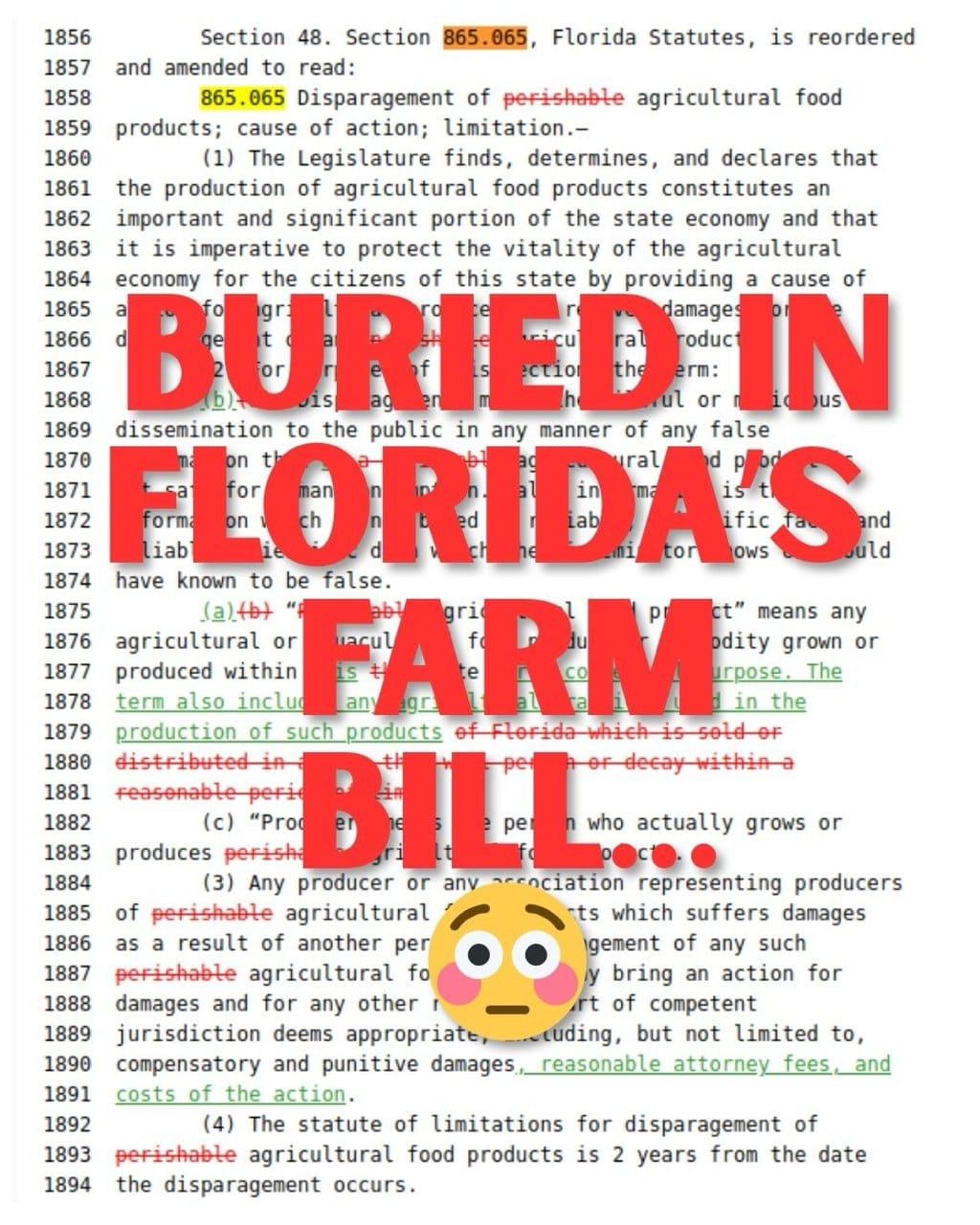
Florida’s Farm Bill includes a quiet rewrite of an agricultural disparagement law that could affect how people talk about pesticide use and farming practices.
It Could Limit Transparency Around Agricultural Practices
Update: January 27, 2026: The bill is temporarily postponed. You have a little more time to get your voices heard!
As a citizen, I find it troubling that complex legal changes with broad consequences require constant vigilance from ordinary people.
I have a job. I have a family. I contribute to my community. I should not NEED to monitor last-minute legislative rewrites to protect my ability to speak honestly about public health and the environment.
When citizens do not have the time or resources to engage, the only voices left are well-funded lobbying groups. That imbalance should concern EVERYONE, regardless of political views.
TL;DR – What’s happening in Florida right now
- SB 290 is a large agriculture omnibus bill moving through the Florida Legislature.
- Buried inside it is a major rewrite of Section 865.065, Florida’s agricultural disparagement law.
- The change would expand the law from perishable food safety to all agricultural products and farming practices.
- This could allow agricultural producers to sue people for criticizing how food is grown, not just for false safety claims.
- Legal experts and advocates warn this could chill free speech, research, and transparency, even when concerns are evidence-based.
- Similar bills across the United States are being introduced to shield pesticide manufacturers from accountability.
- A hearing is scheduled on January 27 2026, and public input right now matters.
If you care about transparency, free speech, or the ability to ask questions about how food is grown, this section of the bill deserves scrutiny... and a word with your legislator. (Example of what I sent is shown at the end of this post).
What is an “omnibus” bill, in plain English
An omnibus bill is a single, very large bill that bundles together many different and sometimes unrelated policy changes.
Why this matters:
- Lawmakers may support most of the bill while missing a harmful section.
- The public has less time to understand what is being changed.
- Controversial provisions can pass quietly when folded into a larger package.
SB 290 is exactly this kind of bill. While much of it focuses on the Department of Agriculture and Consumer Services, Section 865.065 contains a legal change with broad implications that deserves independent attention.
What Section 865.065 was originally meant to do
Florida’s agricultural disparagement law was created to address a narrow and specific problem.
Originally, it was designed to:
- Protect farmers from knowingly false and malicious claims
- Apply only to perishable food products
- Focus on claims that a product was unsafe for human consumption
The intent was to prevent deliberate misinformation that could cause sudden consumer panic, not to silence discussion about farming methods, environmental impacts, or chemical use.
That original purpose matters.
What SB 290 changes in Section 865.065
If passed, SB 290 would significantly expand the scope of this law.
Key changes
-
Increases litigation risk for critics
People who speak publicly about pesticide use, chemical drift, or environmental impacts could face lawsuits. -
Allows punitive damages
This raises the financial stakes, even for people acting in good faith. -
Expands coverage to “agricultural practices”
Not just claims about food safety, but claims about how food is produced. -
Removes the word “perishable”
The law would apply to all agricultural products, including non-perishables.
Why this raises transparency and free speech concerns
This is not about protecting lies. Florida already has defamation laws that address false statements.
The concern is that this change:
- Pushes scientific and environmental debate into the courtroom
- Treats evolving research as potentially “false information”
- Punishes people through the legal process itself, even if they ultimately win
The chilling effect in real life
Consider who could realistically defend a lawsuit brought by a large agricultural operation:
- A university researcher publishing new findings
- A journalist reporting on pesticide use
- A nonprofit sharing peer-reviewed studies
- A neighbor documenting chemical drift
- A small farmer speaking up about nearby spraying practices
Even the threat of litigation can be enough to silence people.
Why pesticide scrutiny is especially at risk
Across the country, there is a growing national trend toward immunity bills.
These laws aim to:
- Block “failure to warn” lawsuits if a pesticide is EPA-approved
- Defer entirely to federal labeling, even as science evolves
- Reduce accountability for chemical manufacturers
When paired with SB 290’s expansion of Florida’s agricultural disparagement law, the effect is cumulative:
- Harder to sue manufacturers
- Riskier to criticize pesticide use
- Less transparency for the public
This directly affects how Floridians can talk about widely used agricultural chemicals, including glyphosate and others.
Who benefits most from this change
Supporters argue the bill protects agriculture from meritless claims.
In practice:
- Large, well-funded operations benefit the most
- Legal risk falls disproportionately on individuals and small organizations
- The law becomes a one-way shield rather than a balanced protection
Small farmers, neighbors, researchers, and journalists do not have in-house legal teams.
Why contacting legislators matters
State senators and representatives rely on constituent input to understand how laws affect real people.
They hear from professional lobbyists every day. They often hear very little from ordinary residents unless there is urgency.
If citizens do not speak up:
- Lobbyists define the narrative
- Complex bills move forward without resistance
- Consequences are discovered only after laws are in effect
This is one of those moments where timely public feedback can make a real difference.
What you can do right now while there is still time:
Email your Florida State Senator
You can copy and paste the message below and personalize it if you wish.
Subject: Please oppose changes to Section 865.065 in SB 290

Dear Senator,

I am writing as a Florida resident to respectfully ask you to oppose the proposed changes to Section 865.065 of the Florida Statutes included in SB 290.

I support Florida agriculture and understand why this statute was originally created to protect farmers from knowingly false and malicious claims about food safety. However, the proposed revisions go far beyond that original purpose and raise serious concerns about transparency, free speech, and public accountability.

My concerns include:

- The removal of the limitation to perishable food products, expanding the law to all agricultural products
- The inclusion of “agricultural practices,” not just claims about food safety
- The increased risk of litigation for researchers, journalists, neighbors, and small farmers who speak in good faith
- The chilling effect this could have on scientific research and public discussion of pesticide use and environmental impacts
- The fact that existing defamation law already provides remedies for false statements

These changes appear unnecessary and risk silencing important, evidence-based discussion about issues that directly affect public health, the environment, and rural communities.

I respectfully urge you to reject or remove the changes to Section 865.065 from SB 290.

Thank you for your time and for considering the concerns of your constituents.

Sincerely,
[Your Name]
[Your City or County]
Call script (30 to 45 seconds)###
Who to call: Your Florida State Senator’s office
What to say:
Hello, my name is [Your Name], and I am a constituent calling to ask the Senator to oppose the changes to Section 865.065 included in SB 290.

I support Florida agriculture, but I am concerned that expanding the agricultural disparagement law to include farming practices could chill free speech, research, and public transparency.

Please let the Senator know I would like this section removed or rejected. Thank you for your time.
List of Florida Senators:
The following lawmakers are Florida State Senators who serve on Senate committees responsible for reviewing and advancing legislation like SB 290, which means their input can directly influence whether these changes move forward.
Sen. Kathleen Passidomo
850-487-5028 passidomo.kathleen.web@flsenate.gov
Sen. Shevrin D. “Shev” Jones
850-487-5034 jones.shevrin.web@flsenate.gov
Sen. Bryan Avila
850-487-5039 avila.bryan.web@flsenate.gov
Sen. Lori Berman
850-487-5026 berman.lori.web@flsenate.gov
Sen. Jim Boyd
850-487-5020 boyd.jim.web@flsenate.gov
Sen. Jennifer Bradley
850-487-5006 bradley.jennifer.web@flsenate.gov
Sen. Jason Brodeur
850-487-5010 brodeur.jason.web@flsenate.gov
Sen. Danny Burgess
850-487-5023 burgess.danny.web@flsenate.gov
Sen. Colleen Burton
850-487-5012 burton.colleen.web@flsenate.gov
Sen. Tracie Davis
850-487-5005 davis.tracie.web@flsenate.gov
Sen. Nick DiCeglie
850-487-5018 diceglie.nick.web@flsenate.gov
Sen. Don Gaetz
850-487-5001 gaetz.don.web@flsenate.gov
Sen. Ileana Garcia
850-487-5036 garcia.ileana.web@flsenate.gov
Sen. Erin Grall
850-487-5029 grall.erin.web@flsenate.gov
Sen. Gayle Harrell
850-487-5031 harrell.gayle.web@flsenate.gov
Sen. Ed Hooper
850-487-5021 hooper.ed.web@flsenate.gov
Sen. Jonathan Martin
850-487-5033 martin.jonathan.web@flsenate.gov
Sen. Rosalind Osgood
850-487-5032 osgood.rosalind.web@flsenate.gov
Sen. Jason Pizzo
850-487-5037 pizzo.jason.web@flsenate.gov
Sen. Ana Maria Rodriguez
850-487-5040 rodriguez.anamaria.web@flsenate.gov
Sen. Darryl Ervin Rouson
850-487-5016 rouson.darryl.web@flsenate.gov
Sen. Corey Simon
850-487-5003 simon.corey.web@flsenate.gov
Sen. Jay Trumbull
850-487-5002 trumbull.jay.web@flsenate.gov
Sen. Tom A. Wright
850-487-5008 wright.tom.web@flsenate.gov
Links:
Senate Bill 290:
https://www.flsenate.gov/Session/Bill/2026/290/?Tab=Amendments
Senate Bill 290 Text:
https://www.flsenate.gov/Session/Bill/2026/290/BillText/c2/HTML
Committee on Rules:
https://www.flsenate.gov/Committees/Show/RC?pref=full